Showing posts with label Piccadilly Theatre. Show all posts
Showing posts with label Piccadilly Theatre. Show all posts
Friday, 12 May 2017
Review Three Sisters
Peter Barker is swept along by an epic production charting the lives and longing of the three daughters in the Prozorov household
Three Sisters (Три сeстры)
by Anton Chekhov
We Didn't Start The Fire
http://www.atgtickets.com/shows/the-sovremennik-theatre-season/
There's something greater than energy alone in this Russian language production of Chekhov's 1900 classic family drama. The heartfelt outbursts, arguments and anger seem to explode in great fires in contrast to the more philosophical interludes.
For the three sisters, schoolteacher Olga (Olga Drozdova), unhappily married Masha (Alyona Babenko) and playful youngest Irina (Victoria Romanenko), the past is glamorous and meaningful. The present is mundane and even unpleasant, defined by the realities of their lives.
Director Galina Volchek teases out the psychological nuances and waves of the drama both with the performances and the staging by Slava Zaitsev and Petr Kirillov on a bare stage with only furniture to evoke the household.
However, it's the revolve which underlines the confusion and inner turmoil of the sisters when their passions rise and their fates bear down on them. In one memorable moment Irina runs to save her fiancé from his fate, charging onward but getting nowhere.
In a Russian production with English surtitles, Babenko captures Masha's complexities, along with her warmth and passion.
Romanenko’s girlish, passionate Irina makes the jump to adulthood with her raw anger at unwanted male advances and the direction of her life. Drozdova's controlled performance as Olga, the eldest and the rock for her sisters, delicately conveys her strength without an arsenal of emotional fireworks.
While Moscow is an historical reality, the three sisters' home in their youth, it is also a state of mind -- a brighter future, a more fulfilled life.
Around them in the provincial garrison town are men who are all in some ways either lacking or wanting -- the sisters' brother, the weak but academic Andrei (Ilya Lykov) doting on his child married to the ghastly Natalia (Yelena Plaksina).
There is the resigned and drunken doctor Chebutykin (Anatoly Uzdensky), the aggressive young officer Soleny (Ilya Drevnov), the refined lieutenant Baron Tuzenbach (Shamil Khamatov), Masha’s inadequate husband Kulygin (Sergei Yushkevich), and the new garrison commander Vershinin (Vladislav Vetrov).
This is a thrilling production of a classic play and altogether a grand theatrical experience. Galina Volchek, also artistic director of Sovremennik for nearly half a century since it was founded during the Khrushchev thaw, deservedly took a standing ovation.
The Sovremennik version is an absorbing and sometimes shocking three hours, demanding and getting total attention. Done with flair, pace and passion, this is an affecting and riveting production is certainly worthy of a green light. Catch it before it finishes on Saturday, May 13!

Friday, 5 May 2017
Review The Three Comrades
A love story set during the upheaval in Germany between the two world wars leaves Peter Barker unimpressed.
The Three Comrades
Adapted by Galina Volchek and Alexander Getman
From the novel by Erich Maria Remarque
Love and Angst in the Weimar Republic
http://www.atgtickets.com/shows/three-comrades/piccadilly-theatre/
Based on Erich Maria Remarque's 1936 novel, The Three Comrades kicks off the Moscow Sovremennik Theatre's short repertory season at London's Piccadilly Theatre.
Three men are all veterans of the First World War trenches, earn a precarious living as car mechanics in late 1920s' Berlin during the Great Depression and the rise of National Socialism.
Chief among the trio is Bobby Lohkamp (Alexander Khovansky), whose friends Otto (Sergey Yushkevich) and Gottfried (Sergei Girin) are the only people he can rely on in the tough circumstances of the doomed Weimar Republic.
The three men live in a world of hard physical work in the garage by day and hard drinking in the shadow world of Berlin’s insalubrious nightlife of cheap bars and sex workers by night.
The disillusioned and cynical Bobby meets a pretty young thing, Pat (Russian TV star Chulpan Khamatova) and the pair fall in love. But tragedy awaits them.
This adaptation, in Russian with English surtitles, is by playwright Alexander Getman and the play's Sovremennik's current artistic chief, 83 year old Galina Volchek as director.
The plot is the only serious problem in this production, but it did hang over the evening for me. Pat’s character feels shallowly written, and she is barely more than a foil for the hero Bobby to take a journey from cynicism to love, only to suffer as a consequence.
In this adaptation the idea a beautiful woman can redeem a good man from his existential misery seems like an outdated cliché. With the plot points clearly signalled, I grasped exactly what would happen shortly before the interval when I was already bored with the predictable love affair and the winsome perfection of Pat.
The second half, when the plot plods interminably towards its consumptive ending, smothers the joy from what should be a showpiece touring production.
The very large cast, with at least 23 named characters, as well as many extras, are well drilled for their roles in a drama which changes scenes at great speed. We sometimes have barely a minute of dialogue in a bar before it moves to the other side of the stage for a tableau in a bedroom, before shifting again to a street or a park scene.
Khovansky as the disillusioned Bobby hardly ever leaves the stage for the two-and-a-half hour production. He gives a very physical performance, at one point effortlessly turning cartwheels as part of his lovestruck euphoria.
Even if one of the main leads is effectively relegated to a piece of scenery, the technical achievements of the production stand out.
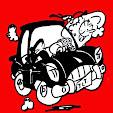
The action takes place on the front half of a huge conventional proscenium arch stage, with no backdrop and only some flats to suggest ruined Gothic architecture. Yet the scenes change quickly, with a series of well-built tableaux, including a 1920s car, rolling in and out.
Director Volchek and designer Pavel Parkhomenko also have an eye for bringing the memorable drawings of German artist George Grosz to life in front of our eyes. Busty sex workers and dishevelled survivors of the war drink away their misery.
The story did suffer for me, perhaps unfairly, in comparison with the musical Cabaret adapted from Christopher Isherwood's 1939 short story inspired by the latter's time in the city.
Remarque had made his name when he struck a zeitgeist with his 1928 wartime masterpiece All Quiet On The Western Front.
Eight years, later having fled Nazi Germany and in exile in Switzerland, Remarque wrote Three Comrades (Drei Kamaraden) about the decade following World War 1. In 1938 it was turned into a Hollywood movie co-written by Scott Fitzgerald starring Robert Taylor.
There were a few glitches with the surtitles on press night but, no doubt, these will be quickly sorted out.
The play suggests that misfortune in life can be transcended through love and friendship. However, it's a red/amber light for, despite good performances and great technical accomplishment, the superficiality of a plodding plot and a heroine reduced to a cipher frankly stopped me from giving a damn.
Subscribe to:
Posts (Atom)


 Posts
Posts

