Showing posts with label Dex Lee. Show all posts
Showing posts with label Dex Lee. Show all posts
Wednesday, 20 September 2017
Review Five Guys Named Moe
Five Guys Named Moe
A Musical By Clarke Peters
Featuring Louis Jordan's Greatest Hits
Here Comes Mr Jordan
https://www.fiveguysmusical.com/
It's only now Traffic Light Theatregoer, aka TLT, has realized that she has motoring form with Louis Jordan, otherwise known as the Father of Rhythm And Blues and the Grandfather of Rock 'n Roll.
In the days before electronic garage doors, one or other of her parents, when they needed someone to hop out of the car and haul up the garage door, would call out tunefully, "Open the door Richard!"
And on car journeys, TLT's Dad would invite us to join in a chorus of "Is you is or is you ain't my baby!" with an accent gleaned from American Forces' radio when he was stationed in Germany just after World War II. For TLT, these were her family's the original call and response songs. 😉
Little did TLT, who duly passed this heritage on to her automotive reviewing sidekick, know these two songs were part of the fascinating recording legacy of bandleader, singer, songwriter snd saxophonist Arkansas-born Louis Jordan who reached the height of his popularity in the 1940s.
Damnit, TLT and her parents were groovy motoring hepcats and she didn't even know it! 😀
Now Clarke Peters, he of The Wire fame, is directing an enjoyable revival of his hit 1990 musical review Five Guys Named Moe, the title taken from a 1943 hit song of Louis Jordan and his Tympany Five.
The quintet of Moes spring to life, emerging fittingly for TLT's family history out of an old-style American radio to chide hapless Nomax (Edward Baruwa) - tunefully of course.
Dishevelled, heavy-drinking, Nomax has done his gal sweet Lorraine wrong. She's upped and left him and he is now moping and toping in his sitting room.
Fittingly as well, this all takes place in a large circus tent-like pop up venue at London's Marble Arch. For Jordan started off his career touring, like his father before him, with the Rabbit's Foot Minstrels who set up tent from town to town.
Like the Rabbit's Foot shows, the plot is negligible - it's the musical and verbal wit and dance, choreographed by Andrew Wright, that drives the show, with a bit of risqué earthy humour firmly of that time.
With a circular walkway, some simple but effective lighting and scenic visuals and a terrific cast and band led by musical director Steve Hill with Jessamy Holder on saxophone, the audience are treated to a generous helping of 26 songs including the eponymous Five Guys Named Moe.
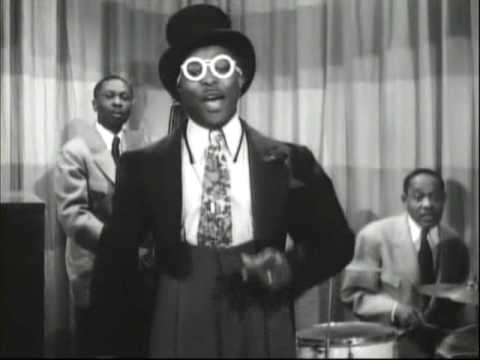
The five zoot suit Moes each of course have their own distinctive personalities - there's Big Moe (Horace Oliver), the leader of the pack, Know Moe (Dex Lee) who sings and knows how to do the splits in mid air, Four-Eyed Moe (Ian Carlyle) who channels Jordan's bespectacled minstrel Deacon Jones persona into a more modern man-about-town.
Little Moe (Idriss Kargbo) who can belt out the songs and transform himself into a Carmen Miranda-type figure and Eat Moe (Emile Ruddock), a guy with a healthy appetite appropriate for the novelty food songs which were also a feature of Jordan's act.
It's loose and lively and has the capacity to be musically informative about Jordan as a pioneer who slid into rhythm and blues and the rock 'n roll era by way, influencing Chuck Berry, James Brown and BB King. The 1949 song Saturday Night Fish Fry even has claim to be the first rock 'n roll song.
TLT was also impressed by the well-designed, attractive tent with bar and plenty of toilets for the ladies - hardly any queues on a crowded press night which deserves a review in itself! 😉The venue and the show is slick and sassy - treat it like "an experience" and it's great.
It is a tad overlong. The songs and dance routines work but when it's stretched out over two hours , it becomes more difficult to understand the evolution of the songs over the years.
TLT and the engine beneath her wings thought this was there in the choice of material, but the length and looseness of the narrative in a large venue drowns it. Nevertheless, it's great fun and a fab venue, so we award an amber/green light

Saturday, 24 September 2016
Review Father Comes Back From The Wars
We at TLT Towers welcome Carolin Kopplin who brings continental spice to the TLT mix! Munich-born Carolin trained as a lawyer and dramaturge before living and working in the USA. She is now a writer and translator based in London and, of course, the newest recruit to the TLT team.
Father Comes Back From The Wars (Parts 1,2 &3)
by Suzan-Lori Parks
Of Human Bondage
A slave on a West Texas plantation called Hero and his personal odyssey through the American Civil War and its aftermath is the focus of Father Comes Back From The Wars. Pulitzer Prize winner Suzan-Lori Parks combines elements of Greek drama with Homer's Odyssey and a philosophical debate on the concept of freedom in a powerful trilogy of plays.
In the first part, "A Measure Of A Man", set in 1862. Hero (Steve Toussaint) is faced with a dilemma. His master has promised to free him if Hero joins the Confederate army. But should he fight against the army that wants to abolish slavery in the South? Or should he maim himself to evade the military? And, even more importantly, will his master keep his promise?
Hero's wife, Penny, (Nadine Marshall) urges him to stay home. His father (Leo Wringer) and many of his fellow slaves, who also make him the subject of a wager, want him to go, not just because they will face severe punishment by the "boss-master" if Hero refuses..
The second part, "A Battle In The Wilderness", takes us on to the battlefield. The Colonel (John Stahl), Hero's master, has captured a Union soldier Smith (Tom Bateman) and keeps him locked up in a tiny wooden cage.
To pass the time, the Colonel plays his banjo and forces his prisoner to sing rebel songs. But Smith changes the lyrics, the Colonel loses interest and instead challenges him on his beliefs about freedom and slavery.
The final section, "The Union Of My Confederate Parts" sees Hero returning from the war and the parallels to The Odyssey become particularly striking. Hero has changed his name to Ulysses, after Commander-in-Chief Ulysses S Grant, and his wife Penny (Penelope from the Greek epic) has been fending off wooers in his absence.
The slaves have been sold off or died with only Penny or Homer (Jimmy Akingbola) remaining. Hero's talking cross-eyed dog Odd-See (Dex Lee) miraculously returns to fulfil the function of Messenger, reporting on Hero's journey and lightening the more sombre mood of this act.
Originally staged at the Public Theater in New York, director Jo Bonney's production now has an excellent British cast. Toussaint's Hero is an imposing presence, the archetype of a hero, yet seriously flawed. Marshall portrays Penny with strength and vulnerability. Akingbola impresses as the rebellious Homer, whose foot was cut off after he tried to run away. Bateman gives a forceful performance as Smith.
Although over three hours' long, this skilfully directed, intriguing work never has a dull moment. Neil Patel's atmospheric set and Steven Bargonetti's bluesy music transport us straight to the American south.
Writer Parks sets the bar high in the first three of nine planned plays, employing ancient forms to tell a still very relevant story. It's a green light for a trilogy uncovering how the precarious position for African-Americans during the long-past Civil War still resonates today.
Subscribe to:
Posts (Atom)


 Posts
Posts