Showing posts with label Jasper Britton. Show all posts
Showing posts with label Jasper Britton. Show all posts
Wednesday, 13 September 2017
Review The Blinding Light
The Blinding Light
by Howard Brenton
Down But Not Out In Paris
http://www.jermynstreettheatre.co.uk/
Fin de siècle Paris and a famous writer is holed up in a seedy hotel doing decidedly weird stuff in the bathroom.
Howard Brenton's new play tangles itself with a few months in the life of Swedish writer, poet and painter August Strindberg, the "other" Scandinavian playwright.
For those not up on world playwriting, Norwegian Henrik Ibsen is probably slightly higher on the league table of Scandinavian playwrights in terms of fame, something which comes up in Brenton's sometimes witty but rather static and opaque take on this episode in Strindberg's life.
It should be enough for anyone coming new to Strindberg and this play to know only this. Certainly there's a pretty strong cast with Jasper Britton as the fiery, choleric Strindberg. He has shut himself away to pursue his weird science - the ancient dream of alchemy to transform base metals to gold.
So much for his theories - the play starts with a face off between the dishevelled and disturbed Strindberg, clad in his underwear and an artisan's apron, his hands stained with the chemicals needed for his experiments and forthright, dark-haired hotel cleaner, Lola (Laura Morgan) trying to do her job.
After that comes a succession of his former wives in what is,possibly a hallucinatory Faustian pageant. First of all, bossy aristocrat Siri von Essen (imperious Susannah Harker), an actress and mother of his two children. Then Frida Uhl (Gala Gordon who could have stepped out of a Gustav Klimt portrait), an Austrian writer, barely out of her teens when she first met and married Strindberg bearing him another daughter.
It's a neat irony that the elder of his wives' real first name reflects an authoritarian piece of Apple software (isn't all "helpful" computer software by its nature authoritarian?). Is Brenton playing on this? Who knows but he and maybe his director Tom Littler in a detailed and measured production?.
Yet in the midst of Strindberg's rantings and paranoia (he liberally takes swigs of what may be absinthe), the occasional futuristic reference crops up. Strindberg, we hear from one wife, "made his excuses and left" like some old-style tabloid hack.
The name of the celebrated movie from Ingmar Bergman (another Scandinavian!) Wild Strawberries also comes into his conversation. Such references and his assailing by inner and outer voices almost turn The Blinding Light into a Stephen King-style science fiction time travelling story.
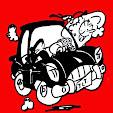
Indeed, despite a polished staging, Max Pappenheim's soundscape made TLT and her own definitely non-imaginary sidekick (a talking, theatre reviewing car, what are you accusing TLT of? 😉) wonder whether this was originally intended for radio and maybe a prospect for a feature film.
This might explain, despite a grippingly intense, feverishly wild Britton and nicely stylized performances from Morgan, Harker and Gale, who cross over "real" life, painting and literature in one fell swoop, why The Blinding Light partly didn't quite work for TLT & Co.
The other part was like the recent Mrs Orwell: the name dropping and theorizing might have the cogniscenti chuckling knowingly. However, unless you know your Wedekind from your Swedenborg, audience members might drift off, drawn in again by only the occasional glimpse of a story.
There is a threat from Siri which finally materializes, only to dissolve through the help of the canny chambermaid. But in the end it feels as if The Blinding Light might work better as an opera with all its internal conflict and duologues with women in Strindberg's life.
Just in case, this sounds altogether too gloomy, it's worth adding there is a sense of irony and some comical juxtapositions transformed into a kind of writer's (and literary agent's) crafty happy ending when Strindberg, transformed, breaks through his own brick wall.
It's 90 minutes with good performances, if sometimes the writing itself seems rather studied and self conscious. There's an ingenious design by Cherry Truluck for Lucky Bert with gravy-brown late 19th century furniture in front of abstract painted screens, spot-on costumes from Emily Stuart and impressive lighting from William Reynolds,
The Blinding Light starts off well and ends well, but the script sinks into rather undramatic verbosity part of the way through, despite some redeeming humour and the best efforts of the director and cast. All in all, the voices assailing the collective mind of TLT and her jalopy whisper amber light.

Tuesday, 4 October 2016
Review The Libertine
The Libertine
by Steven Jeffreys
Monkey Business
http://www.trh.co.uk/
According to this tale, based on true-life literary, louche aristo John Wilmot, Earl of Rochester, it's a bit of a tontine in the playwriting world. If you fall too early, you can well end up the quarry of and as a character in the work of a more acclaimed and financially secure colleague - and rival.
Terry Johnson directs this revival of Steven Jeffreys' restoration romp, pastiche, tragedy (what you will ...) starring Dominic Cooper, which first made its mark in 1994 at the Royal Court as a companion piece to George Etheredge's Man of Mode before a production in the US and a movie 10 years later. Etheredge, my dear sir and madam, appearing as a character in this play - along with a monkey.
The historical Rochester was indeed an outrageous debauchee, hellraiser, whoremonger and cynic who had fought for King Charles II in the wars against the Dutch and whose father had been a loyal supporter of the royals in exile during Cromwell's protectorate.
It was this background that made him a protégé of the King, indulged if banished several times from the court. For Rochester had another weapon as he grew angry and disillusioned, along with many others, with the king's neglect of his country and the corruption of the court - satirical poetry.
In midst of the 1990s, when John Major was prime minister, Jeffreys scored a success with The Libertine following hot on the heels of the successful pairing of The Recruiting Officer with Our Country's Good, directed by Max Stafford-Clark who also directed the first production of this play .
The Libertine is structured around a series of scenes somewhat reminiscent of William Hogarth's A Rake's Progress painted in the century following Rochester's death from syphillis at the age of 33.
This structure is emphasized in this production by the set designed by Tim Shortall. A low, roughly-hewn wood stage stands in front of an oversize gilded picture frame onto which are projected a series of sensual - at first noticeably with women with their heads cut off at the neck - or topographical paintings.
Using also the structure of restoration plays, with a prologue by the libertine himself "You will not like me" and soliloquies by other characters, the characters address the audience between scenes, increasingly in the manner of a court case.
The play itself accepts a disputed premise, that William Etheredge based his man of mode, Dorimant, part of Rochester's circle, on the poet. But otherwise the incidents displayed or alluded to in The Libertine are a recorded part of history.
Not least the portrait of Rochester, a manuscript in hand, about to crown a monkey with a poet's laurel wreath, while the monkey tears pages out of a book and hands a crumpled page to him in his outstretched paw.
It has all the elements of both a lascivious bodice and cod piece ripper (Rochester, so he informs us in his prologue, goes both ways) and a politically and intellectually stimulating play. Yet it doesn't quite deliver on either count.
While Cooper acquits himself tolerably well in the eponymous role, the play feels weighed down by much discussion rather than action. Maybe it's a bad reflection on 2016, but the supposed outrageousness of Rochester and his acts of destruction and self-destruction seem rather tame now.
Still, Jasper Britton has a flourish and presence as King Charles. Will Merrick as young Cambridge-educated spark (Rochester was an Oxford man), Billy Downs is memorable as the young man lured into life as a mini-Rochester. Yet Ophelia Lovibond as Rochester's actress lover Lizzie Barry and Alice Bailey Johnson as his country-bound wife Elizabeth Malet feel curiously static.
It says much that it's at the sitting for the couple's portrait when the play for a short time catches light. Meanwhile the supposed liveliness of the Signior Dildo song as x-rated satire, where the dildos seemed sometimes more like police truncheons, and the carousing and fighting often falls flat.
To be perfectly honest, TLT and her own roistering automative servant found this a frustrating experience. Perhaps wrongly, we were continually asking ourselves, "What does it all mean?". "How does it fit into the 1990s?"
"Or is it some metaphor for the rise of the angry young men playwrights like Osborne and Orton against the likes of Rattigan and Coward?" "Is there a special significance when Rochester is called a romantic?" On the other hand, is it just a rather slight play with a role for a charismatic leading man which is more at home in the cinema than on stage?
There was more momentum in the second act but this felt like an uncertain production of a play truncated in its arguments and action. It's perfectly serviceable but there were longeurs and while it sent us to Signior Google to find out more about Rochester, it's an amber light for The Libertine.
Subscribe to:
Posts (Atom)


 Posts
Posts


