Showing posts with label Jim Bywater. Show all posts
Showing posts with label Jim Bywater. Show all posts
Tuesday, 16 May 2017
Review Richard III
Richard III
by William Shakespeare
Living The Dream
http://www.arcolatheatre.com/
Near the end of the Arcola Theatre's Richard III we gained a glimpse of what this production could have been.
Richard (Greg Hicks) has just been visited in his sleep by those he has wronged and murdered. Suddenly the pangs of conscience cripple him. Hicks's Richard in a nuanced soliloquy envelops us with the cold sweat of the villain as both his past and future merge and he turns his frightened gaze round the audience.
It's a highlight of an otherwise mostly over-emphatic production directed by Mehmet Ergen which nevertheless has other instances of clarity and ingenuity.
Mark Jax's suddenly repentent murderer is both comic and affecting. There's a modern chime to Jim Bywater's Mayor of London, puzzled but then expediently adapting to all the twists and turns, as well as when we hear from Peter Guinness's savvy Buckingham the reaction of the London crowd and the city wives.
Annie Firbank's fine Duchess of York, Richard's mother, conveys a clear-sighted doughty aristocrat, becoming a spokeswoman for the grieving Royal widows dislodged by the son she abhors.
However, at other times we found the inconsistency of the mash up strange and distracting.
The start of the play places us in Italian café society with Richard in black leather - part mafiosi, part Stasi - sipping on wine and spinning a tiny top. When he stands up to the cawing of crows, we see the chain extending from flexed foot to his hands to help him walk. Bespectacled Matthew Sim as Catesby extends the sense of a Communist apparatchik or Fascist henchman carrying out Richard's instructions.
At another time we wondered whether we were in the midst of artisans who decided a change was needed from usual mystery plays, deciding instead to put on the arch-Machiavel's story. Yet the concept seemed tried - and then left behind.
The overpowering television-style sound effects also struck us as intrusive, sometimes unnecessarily disturbing the rhythm and tension of the play.
We've nothing against a production paced television thriller style. But we were far too aware of the sound effects rather than the sound being seamlessly part of the background. In one instance, a very loud cock crow was followed by the information that - er - a cock had crowed.
Anthony Lamble's two tier design is fine as far as the lower space goes, surrounded by the audience on three sides. However, sitting in the seats stage left, we had major sightline problems for the upper tier. The raised walkway running above our seats blocked our view of the second tier at the back of the space and the actors above mainly had their backs towards us. This felt like a thoughtless piece of staging.
Hicks certainly has the potential to be a great crow-like Richard III but we felt he was hampered by more than his chains in an uneven production which needed more variety in its pacing. Individually there were some fine performances and good moments but overall it's an amber light.

Thursday, 23 February 2017
Review The Cherry Orchard
A modern-dress version of Russian classic The Cherry Orchard sparks thoughts on revolution for Peter Barker as part of a provocative season at the Arcola Theatre.
The Cherry Orchard
by Anton Chekhov
This Land Is Your Land
http://www.arcolatheatre.com/
Anton Chekhov’s final play The Cherry Orchard can be seen as an elegy for a lost world and for the British there may once have been a temptation to co-opt it into a post-imperial mindset. Or at least to look on the First World War as a watershed between the unpleasant now and the elegant past.
This 1977 adaptation of the play by playwright Trevor Griffiths, from a translation by Helen Rappaport, resolutely sets itself against a post-imperial reading; but it’s certainly post-something.
First produced at the Nottingham Playhouse, this is now the first time Griffiths’ adaptation has reached a London stage. However, this version did have an outing on television in 1981 in a technically groundbreaking BBC production.
Griffiths maintained he wanted his English version to revolutionize a play "seriously betrayed, almost consciously betrayed, over some 50 years ... The English still cling wilfully to the idea that the play is an elegy for the decline of civilization."
So now the Arcola Theatre's artistic director, Mehmet Ergen, who also directs, has positioned Chekhov's final play as the last in a season of plays looking at revolution -- Maxim Gorky’s The Lower Depths and the New Nigerians by Oladipo Agboluaje making up a trio.
Chekhov in 1904 is no revolutionary although, like many others at the time, he sensed change was coming in his Russia and an overthrow of the old order. But there is no act of violence dispossessing the Ranevsky household of its renowned cherry orchard and other property. An off-stage property deal shunts them into the sidings.
A successful practitioner of a later revolution Mao Zedong, albeit responsible for the deaths of tens of millions, famously said: “革命不是一个请客吃饭 The revolution is not a dinner party.” But in Chekhov’s hands the social revolution does feel like a dinner party with a covert seismic shift, emphasized in this modern dress production.
The cherry orchard is part of Madame Ranevsky's debt-ridden estate. on the verge of being auctioned off when, further stripped of her wealth by a treacherous lover, she's rescued from Paris.
We follow her emotional and economic journey and Sian Thomas's Madame Ranevsky, as she slides from the imperious to the disorientated, still manages to keep our sympathy for this deeply flawed character.
Indeed, her powerful verbal disembowelment of the eternal student Trofimov (an eloquent and convincing Abhin Galeya) makes her grow in stature in our eyes, without ever becoming a frightening monster.
The household of decay also includes Jack Klaff’s charmingly eccentric but feckless Gayev, her brother, who is even less capable of leading a responsible life than Madame Ranevsky.
Set against the old order is the upwardly mobile entrepreneur Lophakin, Jude Akuwudike, the son of a freed serf who inevitably brings down his old patron as he climbs up.
He dances in joy tinged with bewilderment as fortunes change in his favour. His vision of the cherry orchard hanging with bodies of the dead from the past has a gruesome reality in hindsight, although in 1904 it is not yet revolution, just a changing of the guard.
Along with the eternal student, there is the eternal serf Firs, who views his class's emancipation as a disaster, captured in Robin Hooper’s doddering performance with his eye set on a past which is more certain because it is history.
Jade Williams gives a restrained but suitably self-denying performance as Varya, Ranevsky's adopted daughter. Equally, Simon Scardifield does a comic turn with glorious timing as the clumsy clerk Yepikhodov. But all are scooped up in unwelcome change.
Yet others look like emerging intact. Jim Bywaters' wonderfully gritty and humorous landowning neighbour Pischick still looks like a winner. And we can guess that Lily Wood’s sexy and thoroughly convincing ingénue Dunyasha will also be on the rise, perhaps alongside Ryan Wichert’s confident manservant Yasha.
Iona McLeish’s spare white set dominated by an unfeasibly tall bookcase is highly adaptable, aided by David Howe's lighting and sound by Neil McKeown, which draw us into the world of ghosts and dreams that is the cherry orchard.
But it is to the future, pregnant with danger and uncertainty, that Ergen would like to direct us. If at one point, Pischick does say, “Something will happen, you see; if not today, then tomorrow.”, it feels like an inclusive moment for all of us.
Change is afoot. Chekhov never saw later revolutions, when a class of people overthrew another by an act of violence. We are now post-imperial, post-Cold War, post-Brexit, post-Trump election and this thought-provoking amber/green light production may well point us towards a post-dinner party world.
Tuesday, 17 January 2017
Review The Lower Depths
The Lower Depths
by Maxim Gorky
Translated by Jeremy Brooks and Kitty Hunter-Blair
Memoirs of A Super-Tramp
http://www.arcolatheatre.com/
Maxim Gorky had of course more claim to fame than being the lover of politician Nick Clegg's great great aunt. Before several nominations for the Nobel Prize for Literature, he tramped across the Russian Empire, using the experience to fuel his later crusading politics, journalism, books and plays.
The Lower Depths, written at the beginning of the twentieth century, is an ensemble piece charting a few tumultuous days in a doss house, literally the lowest of the low. According to that worthy tome, Wikipedia, it was subtitled Scenes From Russian Life and it has the vigour of a Hogarthian progress as the types and their individual fates crisscross the stage.
Director Helena Kaut-Howson takes on the ambitious task of mounting a production in the fringe Arcola space with an eighteen strong cast clad in a mash-up of modern costumes and accents. The action revolves in part around the arrival of elderly super tramp, Luka (Jim Bywater) who, with a touch of a Capraesque guardian angel, scatters a little humanity on the suffering and brutalized inhabitants.
But he has a tough job. The dank netherworld with its echoing dripping pipes is the property of grasping and religiose landlord Kostyliov (Ian Barritt) and his snarling wife Vassilissa (Ruth Everett). She is cuckolding her elderly spouse with one of the lodgers, virile thief Vasska (Doug Rao) but his eye has wandered over to her younger sister red-haired Natasha (Katie Hart).
It's a lengthy evening where the translation of Jeremy Brooks and Kitty Hunter-Blair brings to the fore, we thought, a strange sprinkling of the Russian literary masters combined with the self conscious style of the Moscow Arts Theatre combined with Gorky's gritty, if sometimes schematic, social realism.
OK, we'll come clean (cleaner than the folks who live in this grimy cellar at least). We're not experts on Russian literature, or anything Russian, but we've read Dostoevsky's tale of murder and spiritual redemption Crime And Punishment, seen Gorky's other plays Philistines and Summerfolk. in translation again, and have an inkling of what Tolstoy is about.
Bywater's Luka as Gorky's secular pilgrim manages to avoid pure sentimentality. Everett's Vassilissa slouches convincingly as the venal wife. Simon Scardifield's actor is poisoned by alcohol and losing not just his mind, but his lines. James Simmons's Baron, born into a titled family and a former government official, battles with low life Nastya (Jade Williams), aching for the love she finds in cheap novelettes. The louche Satin - Jack Klaff - and Rao's muscular crook and lover Vasska are all distinctive characters.
Nevertheless this can't disguise this is a play, with its actorly alternte turns, that could do with some trimming, It may naturally have been revolutionary back in 1902 with its stew of literature, corruption and death laced with black humour. But despite some inventive use of accents to give it modern currency, a more radical translation might bring something more to the surface. Still, it's an amber light for a classic play we're glad to have seen.
Thursday, 23 April 2015
Review Clarion
Clarion
by Mark Jagasia
Drop The Dead Newspaper
http://www.arcolatheatre.com/
The play follows one day in the life of The Clarion trumpeting out its Little England headlines. Morris
Honeyspoon (Greg Hicks in fine full-throttle, bulldozer mode) is the bigoted, rampantly
imperialist editor pandering to the lowest common denominator in an “issue-led”
paper.
by Mark Jagasia
Drop The Dead Newspaper
http://www.arcolatheatre.com/
Over eighty years ago Ben Hecht and Charles McArthur, both
seasoned hacks, wrote “The Front Page”
With several classy movie adaptations, and despite the plethora of
satiric plays and films since then on the press, they remain a tough act to
follow.
They are of course American and we in Britain now have had the phone hacking
scandal. With the print newspaper industry on the ropes, journalistic practices
have themselves become the news story and
subject of plays such as the National Theatre farce Great Britain by Richard
Bean.
So does Mark Jagasia, first-time playwright, formerly of the
Daily Express and Evening Standard, bring
anything new to the newspaper office genre?
His sparring partner is Verity Stokes (a magnificently
despotic Clare Higgins), veteran foreign correspondent churning out columns in
a permanently whiskey-sodden haze at The Clarion offices, allowed (rather out-datedly?) a long leash
for her expenses.
On a lower rung are "immigration correspondent" Joshua Moon (Ryan Wichert) and news editor Albert Duffy (Jim Bywater) with evangelical executive
Clive Pumfrey. (a nicely-judged performance from Peter Bourke) heading the
London office.
At the top of the pyramid is never-seen bottom-line proprietor
Benny Panagakos, newspaper, topless hamburger chain and care home mogul.
Last, but not least, lawyer’s daughter, fresh out of a
degree course, Pritti Singh (Laura Smithers), the ambitious work experience
trainee determined not to be sidelined.
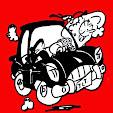
TLT’s automotive companion surprisingly confessed to always
having dreamed of being an intrepid reporter stepping into the shoes of an
elegant foreign correspondent like the late James Cameron or, even in this often tawdry new media world, a strictly ethical investigative journalist as in Lou Grant.
And
not even slight disillusionment when TLT
informed the prospective press corps' member that Lou Grant does not exist, and no
true hack should mix up fact and fiction, has dimmed the petite limousine’s idealism.
So our theatregoing buggy was especially keen to see what
this new piece would bring to the journalism-themed table!
In our opinion, the script, especially in the first act,
often had the feel of a well-worn sitcom. At the same time, although the
characters are ones we may recognise, the actors up the entertainment value,
clearly relishing meaty roles and providing the laughs.
They launch
themselves into a striking, updated Hogarthian or Gillray cartoon,
with the visual taking precedence – the image of Morris strutting around in
full Roman helmet regalia, the louche Verity, complete with gilt handled walking
stick to prop her up, the bluff but craven news editor Albert, the ditzy but
pushy would-be young showbiz reporter Pritti, all tight skirt and tottering
high heels.
The emphasis on the visual perhaps explains a filmic feel to
the script and short scenes, proficiently directed by Mehmet Ergen. Despite later more
theatrical darker plot twists, this felt like movie or TV to TLT and sidekick
rather than a play.
The take-over of showbusiness and celebrity (an impressive
performance by Laura Smithers which, ultimately, made us wonder if the play might once
have meant to be A Work Experience Girl’s Progress!), the change from trade to
graduate career, the selective reporting, political incitement, the deracinated
nature of journalism as its former purpose disappears into the internet ether –
no one would doubt these are all issues on the boil in the pot of journalism,
even if they are well-known.
But TLT and her bonneted companion (who wouldn’t mind an
old-style pork pie press hat ;) ) are in two minds about this play – reflecting its own split personality. Maybe the writer’s own experience of
journalism has given way a little too much to conventional playwriting tropes and self-conscious literary antecedants.
Or maybe the lurches from sitcom to drama would work better on screen.
Yet in our opinion the market for satire on the media and
the tour-de-force opportunity for the actors playing the main protagonists will
probably be enough to give it a life beyond this run. An amber light for a characterful piece.
Subscribe to:
Posts (Atom)


 Posts
Posts

